The Scrambled Egg - a blog every sales professional should wake up to.

Not All Champions Are Created Equal in Sales

Posted by Katharine Derum on Wed, Mar 27, 2013 @ 07:03 AM

Liking these tips? Follow @KADScrambledEgg on Twitter for wisdom on #sales and #salesmanagement.

Ever lose a sale even when you were working with an internal champion? While the termdescribe the image “champion” is used regularly in sales, it’s all too frequently used carelessly. Most commonly a champion is known as someone who will “tear through walls” to get a deal approved. Many deals can be closed by working with an internal champion, however you should know which level of champion as they are not all created equal.

Let’s use superheroes as an analogy to explain the difference in champions. Say you’re in a situation where you need help. If you could only pick one superhero, who would you pick between Batman and Robin? While Robin can still save the day, you know he’s second best. If Robin showed up you might wonder “where the heck is Batman?” You want the guy with the Batmobile and super weapons to come to your rescue, not the one superhero who sits in the sidecar of the motorcycle.

 describe the image

Here is how to identify which superhero you’re working with: 

Batman: This is the top of the line champion and has the best chance of aiding in closing the deal. There are two important distinctions with this champion. First, Batman will have you present to The Decision Maker(s). Second, Batman will coach you on your presentation. Allow him to coach you and write everything down, however don’t assume he knows the information you need. Facilitate his coaching by asking some of the following questions:

What does the _____ (decision makers) talks about most often in meetings?

What are ________ trying to do with the company?

Why is this a priority now?

Why would _____  say no?

What questions or objections are you anticipating?

What else have I missed or what less should I look out for?

Tell me a bit about ________ personalities.

Robin: As we’ve established he is second best to Batman. The difference between Batman and Robin is Robin will be presenting to the Decision Makers, not you, however he will let you coach him on his presentation. It’s best to try and upgrade Robin to Batman first before you offer to coach him. 

How to turn Robin into Batman:

1) Ask Robin why The Decision Maker(s) might say no. When he answers, ask him how he’d handle the objection. In most cases, Robin will not know how to answer. This is the opportunity to tell him (not ask) that it’s really best if he allows you to present. Tell him you handle questions like these daily and you wouldn’t want him to be put on the spot with something you’ve answered 100 times.  

2) An alternative is to ask Robin an objection you, the sales person, hears most frequently. Be silent and let him struggle to answer. This again opens the door for Robin to realize it’s best to let you do your job by letting you sell.

3) One of my sales reps, Alison Bridgman, asked her Robin, “What’s your elevator pitch?” When he didn’t have an answer, he understood he wasn’t equipped to present and upgraded himself to Batman by allowing her to present. Shazam!!

If Robin won’t or can’t upgrade (sometimes there are legitimate reasons), the next best thing is to coach him on his presentation. At least you, as the rep, will still have some control over what is being presented to The Decision Maker(s). Pow!! You should ask Robin when the presentation is, who will be in the room (job titles and names), ask him to send you his presentation and ask how long the meeting is. Most Robins are more willing to send their PowerPoint if you explain you have materials you can send for their deck and save them time.

Most presentations, prior to your coaching, will include information about why Robin wants your product or service. The presentation is not typically catered to The Decision Maker(s) interests. Do not assume Robin knows how to position your product. Ask Robin the same questions you would ask Batman (listed above) and coach him on how to cater his presentation to The Decision Makers’ interests. 

If Robin won’t share his deck or worse, he doesn’t have a deck or a scheduled time to actually present, you may in fact be working with The Joker.

The Joker. This is a person who may say a lot of the right things, however they don’t do the right things. They may even say they are your champion or tell you they are going to fight for the deal. Don’t be fooled. If your contact won’t either coach you or be coached by you, you in fact don’t have a champion at all. Your contact is not bought in. You can either go back to handling objections or stop spending time with this contact and move on.


A champion serves two purposes, either to be a coach or to be coached. The more control a rep can have with a sale, the more likely the deal is to close. If you have no control over the decision maker presentation, it’s best to walk away and work other deals. Your chances of winning a deal you don’t governor are as good as Charlie Sheen staying sober. 


New Call-to-Action

To Sell or Not to Sell? That is the Question!

Posted by Sarah Davis on Tue, Mar 26, 2013 @ 07:03 AM

Shakes

Liking these tips? Follow @KADScrambledEgg on Twitter for wisdom on #sales and #salesmanagement.

Sometimes people ask me “how I do what I do” in sales. It’s simple. I’m confident and passionate about what I have to offer, and I only try to sell to people that I know can/will actually buy the product.

I do think it is important to be passionate about something. Your job, your hobbies, anything really, as long as it’s something that you care about. I happen to be passionate about sales, as well as the company that I work for, and it tends to shine through on every call. Most of the time it is a good thing. I have a tendency to want people to understand why what I have to offer is so valuable, and to get them just as excited as I am about it. This can help tremendously in the sales process in terms of swift movement in purchasing, or selling internally. Sometimes however, it’s not. In the past, I would give my heart and my soul to each presentation without quite realizing if they were worth the price of the show. I’ve found, not surprisingly, that it is just as important to disqualify someone as to qualify them.

Here are some of the things I came across:

Happy Ears: Even if the prospect/s seem interested and seem to be saying yes, if their answers don’t equate a real business need or pain, it is SO much better to move on right there and then than to have “happy ears” and try to sell something to them they don’t need, but think they “might”. They will only end up being unhappy, which in the long run can make you very unhappy. Instead, use a series of pointed questions to sniff out the B.S. and figure out if they are a serious buyer. Don’t be afraid to ask the tough ones like timing and budget either. They are always the most telling.

A Mean Prospect:  Don’t ever let a prospect push you around. I refuse to deal with anyone who doesn't treat me with respect. Your time is just as valuable as theirs (regardless of their title or position), so if they start giving you a hard time or answering your questions with only one word, you should end the call immediately. Every call should be viewed as business conversation with both parties on an even playing field trying to figure out a solution. Plus, even if they do end up buying, who wants to work with a jerk?

Potential Unique Business Fit: Learn your product inside and out so that you can see all of the areas for potential alignment. I’ve found that you should develop a plan that is unique to each prospect, that can help them solve their particular need, vs. a more blanketed approach where you just talk about YOUR product and not how it benefits them specifically. Sometimes you can solve for a little thing that is driving them crazy, and you may not think to address it if you don't know everything you offer.

Wrong Contact: Speaking to the wrong person can lead to a lot of time wasted. As mentioned in this blog previously, a lot of prospects will tell you that they are the decision maker when in reality they have no authority whatsoever and are just educating themselves. Others only have the ability to say no, and are not the ones to sign. Find out if everyone at the company is on board with them looking into this. If so, make sure their buying process is crystal clear so you can get the right players involved.

At the end of the day, this is all about selling as much as you can in as little time as possible. Qualify, qualify, qualify. Also, don’t get too concerned with losses, sales is ebb and flow. Have the confidence to keep on moving until you find the next good fit. It’s so much better to find someone new to sell to who is actually interested and has a need, than to just keep wasting your time on non-buyers or hammering old opportunities that don’t have much likelihood to buy.


Was This Article Valuable? Don't Miss Out! Click Here to Receive New Blog Articles via Email

Topics: Sales

Why Lost Deals Will Increase Sales

Posted by Katharine Derum on Mon, Mar 25, 2013 @ 06:03 AM

Liking these tips? Follow @KADScrambledEgg on Twitter for wisdom on #sales and #salesmanagement.

First things first, this is not an objection handling exercise. This is not a technique to bring a deal back from the dead. Nor is this a suggestion to ask a lost deal for referrals. If a sales person has lost a deal they should accept the news and handle it with grace and dignity by thanking the prospect for their consideration.daisy

While the deal might be dead in terms of revenue there is a massive value a lost prospect can bring to the table. A sales person should ask every lost deal for feedback. By the time a deal is lost a sales rep has put a considerable amount of time into the prospect. Why not at least get something in return? A lost prospect is a wealth of knowledge which can be the secret to success. One can learn why the prospect didn’t go with the product or service and now the rep can learn how to avoid those obstacles going forward. Statistically, one losses more deals than they win. There is actually more feedback and knowledge in lost deals simply because there are more them.

Dead deals can push up daisies. Here are some examples:

1) Over Sold: A sales person may learn from the prospect they were too pushy and aggressive which made the prospect uncomfortable.  

2) Out Sold: A sales person may learn the rep at the competitor out sold them. Ask the prospect what the other rep did and ask for specifics.

3) No Desire: One may learn the prospect doesn’t want the product or service. It’s key to find out why the product or service didn’t make the prospect’s priority list. The rep can use the information going forward to help build desire and urgency.  

4) Competition: If the prospect decided to go with a competitor, this is a fabulous opportunity for a rep to learn what the competitor is saying about their product or service. Going forward a rep can use this to their advantage. If the rep finds out their next deal is looking at the same competitor, tell the prospect what that competition is going to say before they can. This discredits the competition and allows one to give accurate info.

5) Reputation: The prospect might have heard not-so-great reviews about the product or service. The prospect might have found the product or service had no reputation which can also be scary. Street cred is important to prospects. The rep can start incorporating more case studies and offer references going forward.

So how is it done? While a lost prospect has the keys to a reps future success, it can be difficult to access the information. First the conversation should never happen over email. There are too many reasons to list why this shouldn’t be done over email, however mainly because one is not likely to get a reply. Once the a rep has the contact on the phone, the contact is likely to feel this will be an attempt to handle objections. The rep should disarm the prospect by acknowledging they understand the deal is dead. It’s also important to be transparent with the prospect and set proper expectations. This is a phone call a rep should chase just as hard as the rest of their pipeline as it holds the secret to their impending attainment.  Here is a script that can be used:

“Bob, thank you for considering _______ (insert company name). I appreciate you’ve decided to go in a different direction. Since I’ve spent a great deal of time with you I’d like to learn from the experience. I’m going to ask for feedback as I find this is a great opportunity for me to improve. I will not be using this as an excuse to talk you out of your decision or handle objections. Would you be open to giving me feedback?”

Once the prospect has agreed, the rep’s questions can start from there. Do not punish the prospect for being honest. In other words, keep emotions out of it. Do not become defensive, combative or angry. One should also remember this is not a time to handle objections. The prospect agreed to provide feedback because they were told the rep would not try to handle their objections. The rep should not go back on their word.

If you don’t look for feedback, you’ll never improve. Keep doing the same thing you’ve been doing over and over. Maybe someday you’ll get a different result. In the meantime, the reps who embrace failure and seek feedback will send postcards from the achievers trip. 


              Sales Blog

Topics: Sales, Sales Management, Lost Deals

Step-By-Step Guide To Bomb Any Pricing Negotiations

Posted by Katharine Derum on Fri, Mar 22, 2013 @ 00:03 AM

Liking these tips? Follow @KADScrambledEgg on Twitter for wisdom on #sales and #salesmanagement.

Atomic Bomb

Ever had a deal go down in flames at the final hour? It can happen to anyone in sales. Pricing negotiations can be a field of unmarked land mines that are easy to trigger for those who are unfamiliar with the territory. Here are some basic rules to help you trip every possible wire, make every price negotiation an explosive ground, and allow for any deal to go up in smoke. 

Without further ado, your step-by-step guide to bombing any price/contracts negotiation:

Land Mine 1 – “No Commander-in-Chief”: In order to trip the first wire, one should definitely negotiate with the person who can only say no, maybe or play operator. Negotiating with an influencer or champion instead of a decision maker (not the recommender - big difference) is a fabulous way to negotiate at a disadvantage.

How to Avoid Tripping This Wire: If a rep would prefer not to have the negotiations go up in smoke, work only with the person who can say yes. If the influencer wants to enter into negotiations the rep should avoid the conversation. While you don’t want to ignore their request, this is actually a great opportunity to get the Decision Maker involved. Here’s how a rep can avoid tripping this wire and use the situation to their advantage:

“I’d be glad to come up with customized packaging. However, I’m worried we’d be playing operator as I’m not authorized to offer anything exciting. It also sounds like you’d need to check with ______ (insert decision makers name here). Here’s an idea, I’ll grab my manager/director and you grab _________ and we can all schedule a time to talk further. This seems like the fastest way to get a customized package. What time works best with your schedules?”

The above technique allows a sales person to turn a potentially dangerous situation into an opportunity to engage and/or re-engage with power. First, disarm the prospect by acknowledging a willingness to do customized pricing however commit to nothing specific. When a sales rep offers to bring in their boss it serves as collateral for getting the prospect's decision maker. The influencer will feel as though the rep is being accommodating, which the rep is by offering someone of greater power on their end. The influencer is also given a compelling reason to take time out of their boss’ calendar.

Land Mine 2 – “The Cart Before The Horse”: It is best to negotiate prior to knowing if they have decided to go with the rep’s solution or if the prospect is still evaluating other vendors. Even better, negotiate prior to knowing if the prospect has already picked another vendor and are using the sales person as leverage to lower the other vendor’s price. Can you smell the smoke yet?

Elude Tripping This Wire: Only negotiate once there is confirmation the prospect has selected the rep’s product or service. Even if the rep is working with the decision maker do not move forward until they have made a decision. In order to do so, make the assumption the prospect has made decision when they ask for a discount or option. The prospect will have to correct the rep’s assumption. The prospect is lead to their own conclusion they are ahead of themselves.

“Great! We’re looking forward to having you on board. It sounds like you’ve made the decision to go with _______ (insert company name here)?”

The prospect will either say yes or they will have to correct the rep. The rep can then disarm the prospect by acknowledging they will negotiate but put them back in to an accurate timeline.  Here’s how:

“I’d be glad to discuss a customized package, however I don’t want to put the cart before the horse. Let’s first make sure _________(insert company name) is the solution that will take care of your issues/meet your goals”.

Land Mine 3 – “O’Dark Hundred”: Enter into a negotiation without knowing the timeline of the prospect. It’s best to work a deal and have no idea when the prospect is looking to sign up. It's safe for the rep to assume they can do their next pipeline review with smoke signals.

Smokey The Bear’s PSA: The rep should know when the prospect intends to become a customer. A prospect might be asking for options because they’re budgeting for their next fiscal year, which could be months away. In order to clarify timeline, the rep should first disarm the prospect by acknowledging they will address their request while offering no details and then ask for a timeframe. 

“I’d be glad to work on a customized package. It sounds like you’ve decided to go with _______ (insert company name).  When are you planning to finalize a contract?”

Land Mine 4 - “The Mail Carrier”: The best way to bomb a negotiation is to do so via email. It’s best to avoid doing important and time sensitive conversations over the phone or face to face. In order to blow a deal it’s best to lose control of the process, allow the prospect to disappear, let the prospect forward the email to a competitor, and/or let them try to sell the customized package internally. 

Alert! Detour! Bypass! Do not have important conversations via email. Let me repeat, DO NOT EMAIL. DO NOT EMAIL! If you haven’t already read the article why things should not be emailed, do so now. If the prospect disappears the rep will be left with heart palpitations desperately calling the prospect as if it were a bad breakup. Don’t be that rep. Here is the voicemail and email script a rep can use to eliminate negotiating via email:

Bob, per my message –

Thanks for the note. I’d be glad to discuss some customized options. We should discuss on the phone to make sure we cover all details.

Would 10:30EST or 3:00EST work with your schedule?

Best,
ME

I’d recommend avoiding negotiations over email 99.9% of the time. It is VERY rare a rep should resort to email. An example of the .01% of the time would be if the decision maker is on the wing of Captain Sully’s plane floating on The Hudson River with only access to email. If the prospect won’t get on the phone or meet to discuss options, this is an indication of the seriousness of the buyer. Seller beware.

Land Mine 5 – “Vegas Loves You”: It’s best to start offering whatever options one has available without knowing what the prospect might need. It’s best to let the prospect know all the options they can pick from or better yet pick ‘em all! Why not show the prospect all the cards in your hand? If this were a game of poker, the rep would be broke. Vegas baby.

Don’t Be the Oldest Hotel On the Strip Waiting for Implosion: He who says a number or option first loses. Always disarm the prospect by acknowledging you’ll work with them, but offer no details and instead turn the spotlight on them.

“I’d be glad to work on some options. What do you have in mind?”

Land Mine 6 – “The Freddie Krueger”: We’ve all watched the scary movie where the bad guy dies at the end. But we've also seen enough of these movies to know the bad guy always comes magically back to life when it's time for the sequel to come out. How frustrating is it to watch the movie, knowing the bad guy isn’t dead yet and noticing that, once again, blondie doesn’t check to make sure?! He’s behind you!! If you want to bomb your negotiations, proceed without caution and without confirming the first 5 land mines are in the clear. In other words, proceed without checking that the bad guy is actually dead.

Escape the Sequel: Don’t assume you’re on safe ground, yet. Confirm all 5 of the first land mines are cleared before continuing pursuit. Here are some options to confirm you’ve made it safely across the mine field and confirm the bad guy is dead:

“If I’m able to offer ______ (insert what they’ve asked for), what else stands in the way of finalizing the contract?”

“If I’m able to offer ______ (insert what they’ve asked for), when will you be signing the contract?”

“If I’m able to offer ______ (insert what they’ve asked for), would you be able to sign up today?

By starting the sentence with “if”, the rep is not definitively committing to anything. However the rep has still disarmed the prospect by addressing what the prospect has asked for. The prospect should confirm there is nothing in the way and should willingly give a verbal commitment - a conclusive yes.

If the prospect won’t give a verbal commitment, the rep then needs to handle objections. The rep has earned the right to ask why as they are only offering what the prospect wanted and asked for. If the prospect won’t offer verbal commitment or clarification as to why, there are serious red flags with this buyer. Seller beware.

Bombs away! 

Don't Stay tuned! No Content For Monday's Commute! 

Steer the content of The Scrambled Egg by sharing articles via Facebook, LinkedIn or Twitter on the top of each article. Content creation is based on the articles which get the most shares.

If you’d like to nominate topics or areas or sales/sales management you want discussed, contact me.

Don't Miss Out On Upcoming Articles.   Click Here to Subscribe to The Scrambled Egg. 

Topics: Sales, email, Price Negotiations

The Most Common Mistake in Pricing Negotiations

Posted by Katharine Derum on Thu, Mar 21, 2013 @ 05:03 AM

Follow @KADscrambledegg on Twitter for wisdom about #sales #salesmanagement. 

There are several rules to negotiating but the first one is the most important, the easiest to abide by and the one most frequently broken.  cards

Years ago I had a manager who could never be found in his office. He was always outside smoking. For the two years I reported to him my biggest take alway was to quit smoking and to do it right then and there. Good lord he smoked a lot. I’m happy to report I’ve been smoke free ever since.

While The Marlboro Manager offered a good lesson in health, he also taught me the first lesson in negotiating. One day as I was walking in from lunch, I passed him as he was walking out for yet another cigarette. He asked if one of my deals was coming in (this was his form of a pipeline review). I explained I’d given my contact two options and waiting to hear back from them. Smokey The Bear replied in a very husky voice “he who says a number first loses” and he walked away. 

The 1st rule of negotiating: He who says a number first loses.

With that one piece of advice I’d learned the most important rule of negotiation – never say a number (discount) or option (billing terms, shorter contract, etc.) first. Smokey was referring to leverage. If you’ve ever walked into a car dealership, the first thing you’ll be ask is “how much do you want for the trade in?”. The sales person is trained to get the buyer to say a number first. Don’t answer; instead tell them you aren’t sure. The most fun part is the sales person is not trained on what to do if you don’t give a number first.

Think of it as if it were a poker game. One doesn’t want the other player to know what cards are in your hand. As soon as you tell the other person a number, you’re essentially telling them one of your cards. You have now given them leverage. Instead you should find out what’s in their hand first. Here’s how:

When a prospect asks about options, promotions, discounts etc. there are two paths to choose from. The rep can either tell the prospect there are no options, discounts or promotions. The other option is to play ball. Here’s how:

1) Do Not Answer - The are asking you to break the first rule and show your hand and say a number or options firsyt. Hence giving them the leverage.

2) Acknowledge Without Committing - Don’t ignore the question but offer no details. Disarm them, reassure and seem accommodating by saying something generic “I’d be glad to come up with some customized packaging”. You’ve committed to nothing specific at this point.

3) Tipping the Other Hand First - Now get them to show their card and have them say a number or option first “What do you have in mind?”

This is a great way to have a more balanced negotiation. The last thing a rep would want to do is offer a discount when the prospect needed billing installments. Now the rep is stuck having to honor both! Knowledge is leverage and as a sales person you have the tables in your favor. 

Stay tuned! Tomorrow's Article:

5 Step Guide to Bombing Pricing Negotiations


Was This Article Valuable? Don't Miss Out! Click Here to Receive New Blog Articles via Email

Topics: Sales, Price Negotiations

Why Building Rapport is NOT For "Building Relationships" in Sales

Posted by Katharine Derum on Wed, Mar 20, 2013 @ 06:03 AM

hand shake

Follow @KADscrambledegg on Twitter for wisdom about #sales #salesmanagement. 

Sales people only have so much time in a day and should utilize every moment. Rapport building goes far beyond “building relationships”, take the opportunity to gather more information about prospects beyond their kids’ names, the weather, etc. In order to be a top performer a rep must be methodical and calculated in every step, even rapport building. Here are other ways to use rapport building to elicit valuable information from prospects:

1) Lower the Tension – A rep should build rapport at the beginning of every call. This helps to lesion the tension the prospect might be feeling in addition to the anxiety the rep may be experiencing. If the prospect’s guard is down, they are more comfortable and more likely to share. Going straight into a call, without rapport building, can feel like a plane coming into the runaway fast and furious! Slow down….

2) Authority or Influence Level – Rapport building is an excellent way to learn how much power a prospect has internally.

Start By - The rep can make small talk. Ask how long the prospect has been with the company. Are they happy? What do they like/not like? The rep can share stories of their experience at their work place (always remain positive).

What is Actually Gained - Once the conversation is flowing, here’s what the rep can really gain from the chit chat. The rep may find the prospect was newly hired or promoted. If so, why did the company hire or promote for this position? Why was it a priority to do so? The rep can find out who hired the contact. Was it a person in the C-suite? How often do they meet with this person? In other words, while the rep is “building rapport” they are multitasking by lowering the tension, easing their way into the call in addition to finding out if their contact has access to power and how often.

3) Decision Making Process – There are opportunities in the rapport building stage to gather information about a prospect’s internal decision making process.

Start By - Opening the conversation by trying to learn more about their culture. The rep can share stories of their experiences (always positive). Is the prospect’s culture fast paced? Do they have red tape? Are things decided as a group or in silos? Is this a headache? Do they like the process? Why or why not?

What is Actually Gained - While this may seem like small talk, the rep can start to understand their internal process for getting things purchased. The rep is also discovering timeline for how long the deal might take to close.

4) The Slip – Sometimes a prospect will reveal information during rapport building which might be imperative to a sale and otherwise missed.

Start By - The rep can ask if the prospect received the information and what the prospect’s thoughts are. Discuss what they liked and ask for feedback. The rep should have sent product information in addition to information that is strategically helpful. Information offering strategy is more likely to get read and gains trust with a prospect. A sale should rarely be about product/service. 

What is Actually Gained- The prospect’s guard is down and they feel the discussion is more casual or “off the record”. The prospect will reveal information that might have otherwise not been shared in a more “formal” setting. Such information could include, other vendors being evaluated, who internally is for or against the purchase of the rep’s product/service, an impending acquisition which might slow the process down, etc.

A great example would be from when a prospect was 5 minutes late to a schedule call. They’d asked the rep to remain on hold as they were running late. When the prospect returned to the phone they apologized and explained the CEO had pulled him into a last minute meeting. The rep was smart and jumped on the opportunity to gather more information. The rep asked if everything was ok and was it a normal occurrence. The prospect revealed the CEO does this frequently and trusts him to assist in emergencies. Prior to this auspicious interaction the rep was unsure of the contact’s internal power. Now the rep knows the contact had direct access to CEO and the CEO trusts the contact. This is invaluable information to the sale that might have otherwise been difficult to get.

Sales people only have their time. They should be methodical and calculated at every step in order to ensure they’re being most efficient. Work hard and work smart. 

Next Article:

The First and Easiest Rule of Negotiations Learned From the Worst Manager


Was This Article Valuable? Don't Miss Out! Click Here to Receive New Blog Articles via Email

Topics: Sales, Decision Maker, Building Rapport

Why a Sales Person Should Never Reply to a Prospect's Email

Posted by Katharine Derum on Tue, Mar 19, 2013 @ 07:03 AM

Liking these tips? Follow @KADscrambledegg on Twitter for wisdom about #sales #salesmanagement.

Replying to a prospect's email(s) is lazy and a sales rep should break the habit immediately. We’re all busy throughout the day and it can seem like the best way to communicate is to respond to emails. A rep might make the assumption that email is the preferred method of communication for the prospect and will follow suit in this manner. Instead of assuming this is their preferred method of communication, why not assume they’re in meetings and this is their only way to reach out. They are multitasking. Assume this is the case every time and do not reply. Instead view every email as an invitation to call.

Why view every email as an invitation to call? Consider these 8 problems with the email reply: describe the image

1) Loss of Control – when a rep sends a reply the prospect can take the information and do what they want with it. The rep won’t know if the answer was satisfactory or if it wasn’t what the prospect was looking for. No response from the prospect now leaves the rep with nothing but guesswork.

2) Lost Opportunity – every interaction with a prospect is the opportunity to find out more information. Assist in whatever it is the prospect needed and then a rep has the ability to ask such things as, updates on the sale, legal process, decision making process, who else is inquiring (perhaps the email had questions), why is the prospect looking for additional information, etc.  

3) No Accountability – having a prospect on the line makes them accountable to answer questions like those in #2. If these questions are asked in an email it is very rare they will be answered. However, if one has the prospect on the phone, it is hard for them to ignore.

4) No Ability to Sell – additional information might be discovered during the discussion which allows for the rep to take another angle with the sale.

5) Tone Deafness – it is very difficult to understand an email's actual tone. While the prospect’s email may seem innocent in nature, the a phone call and might uncover that there are major hurdles to overcome. On the other hand, the prospect could seem angry and snarky, yet a phone call would have revealed they are very interested and that their office has simply been swamped. Bear in min, this is a two-way street. A sales rep’s tone has just as great a chance of being misread and prospects are not as forgiving with misread tone.  

6) Lost in Translation – it is very easy for things to get lost in translation even over the phone. Email amplifies this chance as you don’t have the ability to quickly ask for clarification and make explanations.

7) Easy to Forward – a rep can hope or assume their answers are only being passed around internally. Don’t make this assumption. The last thing a rep would want is for their email to be forwarded to a competitor and educating them how to sell against themself.

8) Does Not Stand Out – every sales reps replies to email. Don’t be that rep. Pick up the phone and offer assistance.

Ok so you're sold on the idea of viewing all prospect's emails as an invitation to call.  So how does it work? Always call first. If they aren’t there, your voicemail will be the below script and your email will match which will be sent immediately afterwards. Always re-assure them you have answers to their questions or whatever it is they need. In order to get what they need, they’ll have to connect via phone. Make sure to end the voicemail and email with a call to action. Here is an example:

Bob, per my message

It’s nice to hear from you. I’d be glad to help with/answer your questions below. It’s best if we connect over the phone in order to make sure I give the details you need.

I’m open today at 3:00EST or 5:30EST. What works best with you?

Best,

Me

Always leave two suggested open times. A rep should not say they’re open for the rest of the day or available at any time. It’s too desperate and needy. A top performing sales person is busy with other calls and lots in the pipeline. Remember the prospect needs answers to their questions and if those times don’t work they will reply with times that do work. This is also a good indication of their level of interest.

Knowledge is power. Take every opportunity to gather information. View every email is an invitation to call a prospect. Never waste an opportunity, take the invitation, run with it and close some business!

Next Articles:

The Most Common Mistake in Pricing Negotiations

The Hidden Secrets of Rapport Building Beyond "Relationships"

Was This Article Valuable? Don't Miss Out! Click Here to Receive New Blog Articles via Email

Topics: Sales, email, voicemail

Yes Sales Territories Matter! How to Succeed In a Bad Territory.

Posted by Katharine Derum on Fri, Mar 15, 2013 @ 07:03 AM

Territories

There seems to be an unspoken law not to discuss if territory affects the performance of one rep or team versus another. The express goes “there is no such thing as a bad territory”. I’ll be the first to say it.  Unequivocally yes, territory matters.  As a sales leaders, you are doing your teams and reps a disservice by not acknowledging this fact.

While not all territories are created equal, I should clarify on the heels of my previous statement, a bad territory is not an excuse. In fact, I’d argue a rep with a good territory are at a disadvantage. They will not have to work as hard or be as strategic as the rep with the bad territory. They’re missing out on skills and techniques they will later need if territories change or they move companies. A rep with a bad territory has the opportunity and motivation to improve their skills and development. Opposed to the rep with NYC who might have less motivation to make improvements because they’re more easily producing numbers. A successful sales career is a long term game with short term wins that are not always dollars. 

As a sales leader, by denying all territories are not created equal, you are missing the opportunity to develop your team and teach your reps how to yield more revenue from an underperforming area.

Here are the steps a rep can take to successfully work a bad territory:

1) Reverse engineer wins by running a report in your CRM over the last year of all deals closed and look for patterns. You will usually find there are certain industries in that area doing well. Some databases have this by SIC code. If you don’t have access to match SIC code with industry, you can Google the codes.

2) Call the customers who have purchased over the last year.

a. Explain you’re trying to understand their industry better and you’re not trying to sell additional services. People love to talk about themselves.

b. Ask why they purchased.

c. What pain does your product/service solve?

d. How has the current economy affected their industry?

e. Where do they see opportunities to grow?

f. If they are growing it means they have customers purchasing. Ask who their local (or whatever your territory is) customers are and if there is a particular industry they see the most success with. 

g. Ask for the most popular blogs, publications or thought leaders in their space.

h. Ask for a referral and do not call, yet.

i. Tell them you’ll be in the area sometime soon (even if this is not true) and ask their favorite lunch place that deliveries. Ask what’s good on the menu. Call and have that item delivered to the contact that day. Do not ask if they want it, just do it. Also send a handwritten thank you note. Do not email, take the time to write the note on nice stationary. A little goes a long way and the contact might be an additional resource of referrals for you.

3) Top 5 - figure out the top 5 industries between the list of customers who’ve purchased in addition to who’s buying from them.

4) Become a subject matter expert of the top 5. You should become a subscriber to those blogs, publications and follow the thought leaders on Twitter or if they have their own blogs. You should also understand what pain you solve for these companies and what opportunities there is to grow. This positions you as a trusted advisor and will yield more sales.

5) Start Calling. 

a. Call the referrals the current customers gave you.

b. Run another report in your CRM of companies in the top 5 industries who haven’t yet purchased. Provide them with up to date industry topics and offer free advice and strategy.

c. Pay attention for companies mentioned as you read articles and publications and add them to your call list.

While no one is excited to be handed a bad territory, there is only one NYC or LA to go around. Don’t let a territory be an excuse. Take the opportunity to work smart, it’s much more rewarding. Remember this is a long term career and the landscape of sales changes many times. At some point it will be your turn to have a good territory and you can apply the skills you’ve learned to be an unstoppable powerhouse.

Next Article:

4 Critical Techniques To Win The "Internal" Sale

Topics: Sales, Sales Management, Territories

Is Facebook the Next Google or is Zuckerberg Missing the Boat?

Posted by Katharine Derum on Wed, Mar 13, 2013 @ 16:03 PM

describe the image How many of you have noticed the increase in advertisements in your Facebook news feeds?  How many of you like the increased advertisements? I’m going to venture to say not many of us. 

As many of you may recall, Facebook was not the first big social networking site. MySpace was the market share holder prior to Facebook. However many users made the switch to Facebook from MySpace when their user experience became cluttered with banners and pop ups. Facebook needs to be careful not to fall into the same trap.

While our Facebook experience has more advertisements, I believe Zuckerberg is walking a fine line and he’s careful not to cross it. Facebook is generating revenue by selling space on your newsfeed and profile. The ads delivered to you are highly customized banners based on our personal data. We are not yet bombarded with banners which become as annoying as neon signs and I don’t believe we will be.

I’m hoping Facebook will take advantage of the massive and unique opportunity to take over another market leader and create a user experience larger than the sum of its parts. I’m talking about Facebook taking over Google’s market share by becoming the next search engine.

In order to understand how this would work, let’s first do a quick summary of how Google delivers results to you. There are 2 ways Google’s algorithm works to deliver the free/organic search results.

1) Keywords and Phrases. Websites have words and phrases in each page and each page of a website is the opportunity to rank for a new and different keyword/phrase.  Google looks in specific places on each page for those words or phrase to determine if that page should come up in the free/organic search results for that word or phrase. 

2) Inbound Links.  An inbound link is another website linking to the website in question. Let’s say two different websites had the same exact words/phrase in all the right places, Google then prioritizes by which of those websites has more inbound links. 

Now let’s think about the data Facebook knows about you. They know who you are, where you went to school, where you work, who your friends are, where your friends have eaten for dinner and heck even what they ordered sometimes. Every time someone from your network “likes” a business page, “shares” something or “checks in” somewhere, consider this a recommendation or a referral. Word of mouth if you will.

So where is the opportunity for Facebook to take over Google? This means Facebook can deliver results that are exponentially more relevant and personal than Google ever can deliver.  Instead of delivering results based on keywords and inbound links, Facebook can deliver results based keywords in addition to:

1) Who you are (your personal data).

2) Word of mouth recommendations (likes, shares, etc).

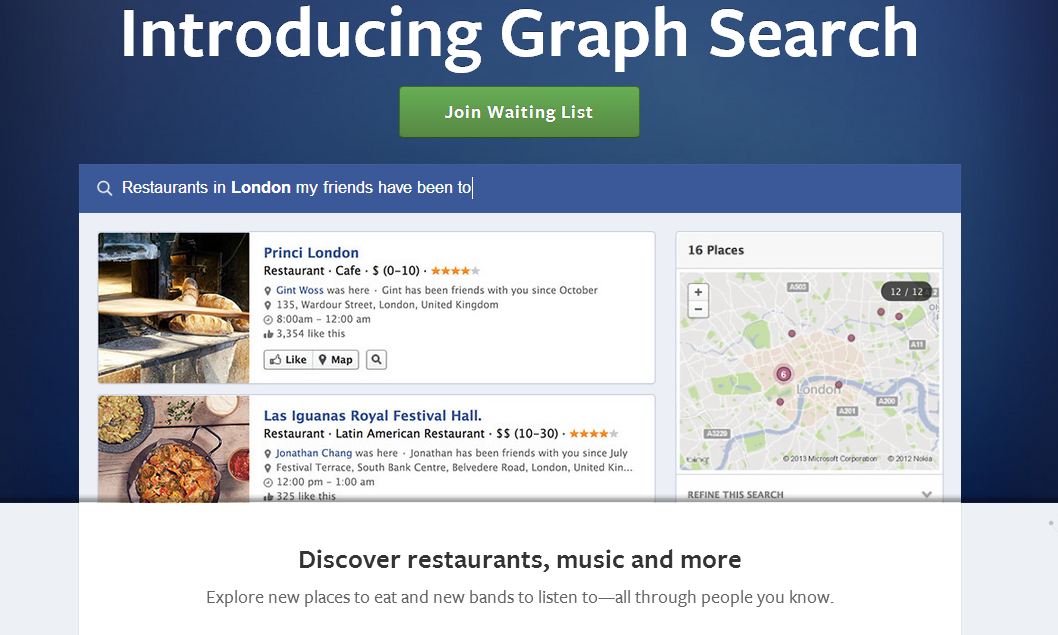
As an example, let's say you Google and look for "restaurants in London". Your first result will be the restaurant that has either paid an SEO firm a lot of money to get to the top or has been around a long time. Now compare that to getting results based upon restaurants in London your friends, colleagues or family have been to. The more “likes” or “checks in” a restaurant receives, the more search results it will appear in.

Take a look at the screenshot below I was able to grab from Facebook's graph search. Look at the blue bar above the picture on the left which reads “restuarants in London my friends have been to”.

GoogleGraphSearch


Wondering how this will affect sales? First, your prospects are online doing research even if you’re a B2B company. If you don’t believe they do their research online – stop reading this article. I’ve already confused you and you’re so far behind you need to go figure out how to turn your computer on. 

Your prospects are using Google to research services and how to solve their challenges. Use the screen shot below and replace the word “restaurant” let’s say with something like “warehouse management services”. Also think about how many times you've received a word of mouth recommendation or referral from an existing customer. 

If Facebook becomes the next search engine, delivering results based upon keywords and word of mouth, you better hope your company has a good social media presence.


Next Article:

Do Territories Matter?


Topics: Sales, facebook, Google

Why You Should Breakup With Your Leads

Posted by Katharine Derum on Tue, Mar 12, 2013 @ 14:03 PM

BreakingUp You’ve all had the accounts you tried relentlessly to get into. You call multiple people in the company and try month after month. Many sales people do this as tenacity has great pay offs in sales. Sometimes the technique works and other times it works to no avail. There is a smarter way to work – dump your prospects. Yes, dump them. It’s over. Kaput. It’s not you, it’s me. Done. Adios.

Breaking up is hard to do. It’s even harder when you think of breaking up with a potential customer. Let’s think about it from a different perspective as it might actually yield the opposite result. In other words, breaking up with your prospects is a great strategy to solicit a response.

First, understand your prospects are busy. They have multiple meetings and many things on their plate. They receive many calls throughout the day and while they may plan to call you back, you’re pushed to the bottom of the list. The prospect knows you’re in sales and relies on you to be tenacious and to do your job by continuing to call and email. This allows you to fall further on their “to do” list.

At some point a sales rep will move on and stop calling the prospect without knowing if the prospect might have wanted to connect. So to make matters worse, the sales rep doesn’t communicate to the prospect you’re no longer going to be calling. Don’t make this mistake. This leads us to the first and most basic rule of breaking up.

Here are the rules to a successful breakup:

1) Communicate to the prospect you are giving up. This way they know they can’t rely on you to continue calling and emailing. If they had any interest in speaking you have now forced yourself to the top of the “to do” list because you’ve told you’re breaking up.

2) Do not breakup too soon. If you pull the plug on a prospect without legitimately first putting in effort the tactic seems, well, like a tactic. You should attempt to connect with your prospects at least 8 times (voicemail or email) before breaking up.

3) Include a tease in regards to strategic advice (not about your product or service) you would like to discuss. This will remind them what value they’ll get if they connect with you.

4) Make it short and sweet, but not too sweet. It should be to the point and don’t be abrupt or offensive. This will defeat the purpose and it will again seem like just a tactic.

5) This is the most import of all rules. You’re previous emails should include increasingly valuable information not about your product, service or company (it’s too soon to pitch). In other words, make sure they care you’re breaking up with them. If you’ve provided value in your previous emails they will care that they’re no longer going to receive them. The valuable information also peaked their interest enough to get you onto their “to do” list in the first place. Voicemail and email attempts solely about your products and service will never even get you to the bottom of a “to do” list. This article discusses how to increasingly add value in each effort to reach a prospect.

Here is an example of a breakup voicemail and email script:

Bob,

I wanted to reach out to you one last time. I have suggestions on how your facebook page and website can work harder in terms of generating new business. If I don’t hear back from you, I’ll assume the timing isn’t right.

My information is below should you have any questions.

Best,

Me

The response rate to a breakup is close to 33%. While most responses are positive and they’ll tell you they’ve been meaning to get back to you, sometimes you’ll also get a response from those letting you know they are not interested. A negative response is still as successful breakup. You now have an answer and can move on; it wasn’t meant to be as they were never going to buy anyway. Breaking up isn’t hard to do once the technique proves itself.  Happy selling and breaking up!


Upcoming Articles:

Facebook is Close to Missing the Boat. Why This Will Affect Your Sales. 

Do Territories Matter?

Topics: Sales, email, voicemail, Basho, the break up